

On September 24, 2026, Vical Peterson Brunious, attorney and senior contract manager at Hartbeat, joined Molten Cloud founder and CEO Arjun Mendhi for the webinar The Evolution of Legal Operations at Media Companies. Vical was one of the first people Hartbeat's general counsel brought on to build the legal department from the ground up, including all of its software: rights management, a document repository, e-billing.
The conversation had two halves, and so does this post. First, how Hartbeat defines the scope of legal operations. Then, how the team has used Molten Cloud to modernize it.
Watch the live discussion with Hartbeat Attorney and Ops Manager VicalThe Evolution of Legal Operations at Media Companies, full session with Vical Peterson Brunious and Arjun Mendhi
How Hartbeat defines the scope of legal operations
Vical opened with a caveat: legal operations varies from one organization to the next, and the role itself has moved over the past few years.
“Years back, I think it was more administrative, and now it's more, I'd say, integrated in the legal department and in the business in general.”
Vical Peterson Brunious, Attorney and Senior Contract Manager, Hartbeat
Arjun then took the six areas Vical had shared with him before the session, one at a time.
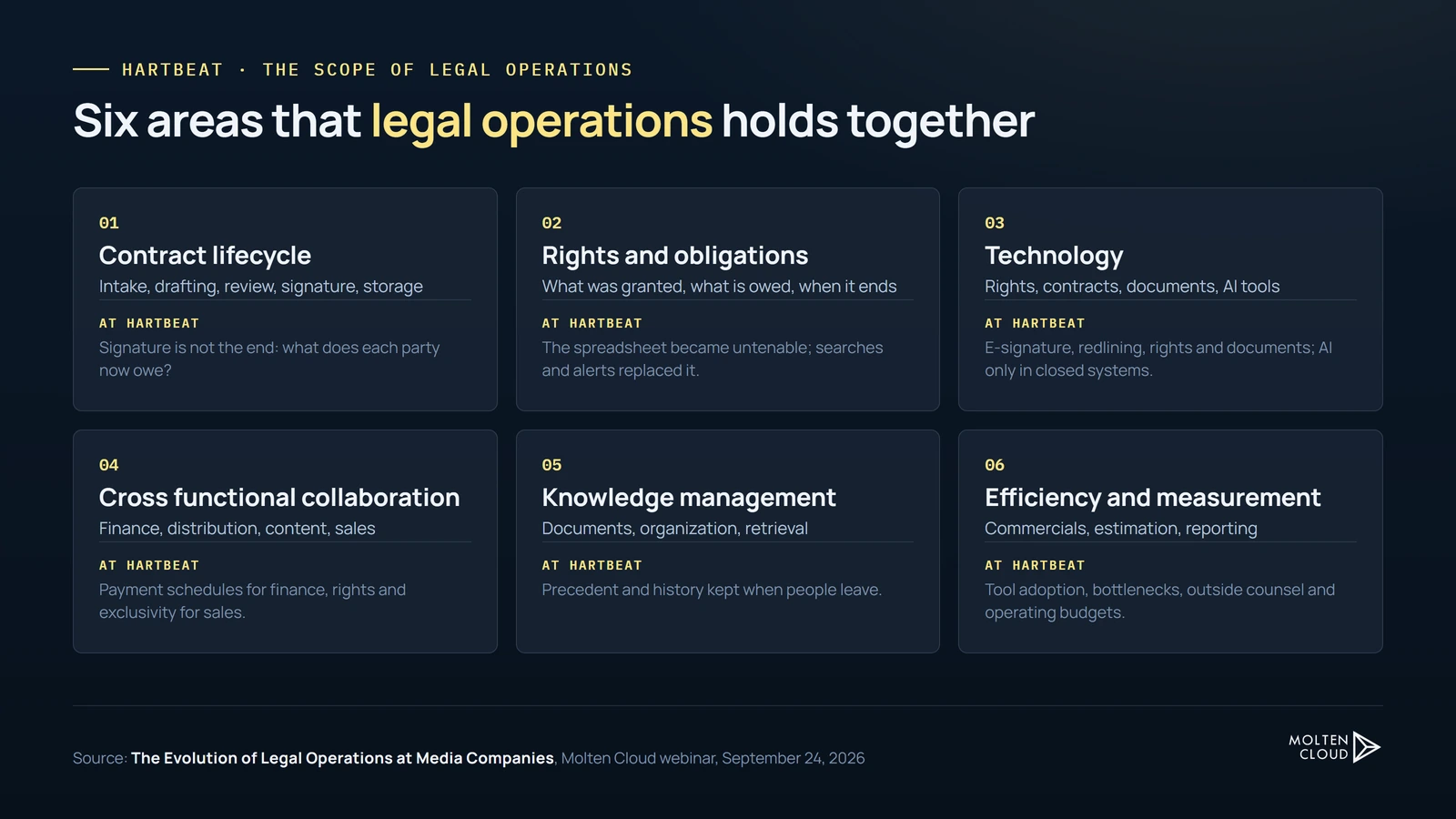
1. Contract lifecycle
The contract lifecycle runs from the initial request and intake, gathering the details from the business team, through drafting, negotiation, review and signature. For Vical, the part that matters just as much comes after: once everything is signed, sealed and delivered, what are the obligations for both parties, what needs to be tracked, and does finance need to be looped in?
The basics are shared with other industries. What changes in media is the range of agreements. For a single film, Vical listed the agreements that secure the rights, options, shopping agreements, attachment and co financing agreements, production services agreements with crew above and below the line, talent, music and library licenses, and finally the licenses that decide where the finished project is exploited.
The tools follow the same path: a document repository to version drafts, signature and approval, a handoff to finance for payments and milestones, and then, depending on the agreement, a rights management system such as Molten Cloud to track rights, dates or revenue share.
2. Rights and obligations
At Hartbeat, as at Vical's previous company, rights started on a spreadsheet that became untenable. Choosing a rights management system meant working with Molten to parse the agreements, design the templates and handle a number of custom asks, and deciding what to track, what the team could realistically maintain, and what people really needed to see.
What a spreadsheet could not give them: search across fields in one place, saved searches for the questions that come back, the summary and the agreement stored together, and reports that flag what is expiring without anyone having to remember to check.
“In a rights management system, you can just kind of plug it in and you just go set it and forget it, and you're just getting the updates.”
Vical Peterson Brunious, Attorney and Senior Contract Manager, Hartbeat
When another team asks what is available, the answer is on screen: bars by title, with the detail underneath by territory, media and language.
3. Technology
Technology in legal operations covers the whole toolkit: electronic signature (Vical remembers the manila interoffice envelopes), redlining, document management and rights management. AI is arriving inside those existing programs, and Vical was clear about the condition attached.
“Every legal team kind of gives a little bit of pause because there is confidential information that you don't want to put in a system. You want to make sure it's a closed system.”
Vical Peterson Brunious, Attorney and Senior Contract Manager, Hartbeat
4. Cross functional collaboration
Legal sits in the middle of the business, and everyone comes to it expecting an answer. Vical's approach is to keep people involved throughout a deal and make sure finance knows what is coming before the end, not after.
Each team asks something different. Finance wants payment terms and schedules, sometimes before a deal is done, for modeling and projections, or simply to know when a vendor should be paid after delivery. Sales and distribution want to know whether Hartbeat still has the rights to a season, for how long, and with what exclusivity, before they go out to negotiate. The studios team hears about rights that are about to expire on projects in development.
“Just to make sure that we're just tracking everything and just trying to not drop any of the balls that are up in the air at all times.”
Vical Peterson Brunious, Attorney and Senior Contract Manager, Hartbeat
5. Knowledge management
For Vical, knowledge management is access to information across the organization: where to find something, who to ask, and what the company has agreed to before. Precedent shapes the next deal: what is standard, what is not, and what the team is willing to agree to.
“Times change, people change, companies change, and you don't want to lose that information when someone leaves the company.”
Vical Peterson Brunious, Attorney and Senior Contract Manager, Hartbeat
6. Efficiency and measurement
Efficiency starts with adoption: technology only helps if people in the company use it. It also means looking at the requests the department receives and finding the bottlenecks, without taking legal's eyes off anything that needs them.
“Identifying possible bottlenecks and trying to resolve them in an efficient manner that isn't sacrificing work product.”
Vical Peterson Brunious, Attorney and Senior Contract Manager, Hartbeat
Measurement is reporting: Vical tracks the department's outside counsel spend and its operating budget, software included, and uses the year's pattern to plan the next one.
How Hartbeat has used Molten Cloud to modernize legal operations
The second half of the webinar followed the life of an agreement after signature, in ten steps Vical had outlined before the session. Most of them she described from her own use; where Arjun explained a step, the text says so.
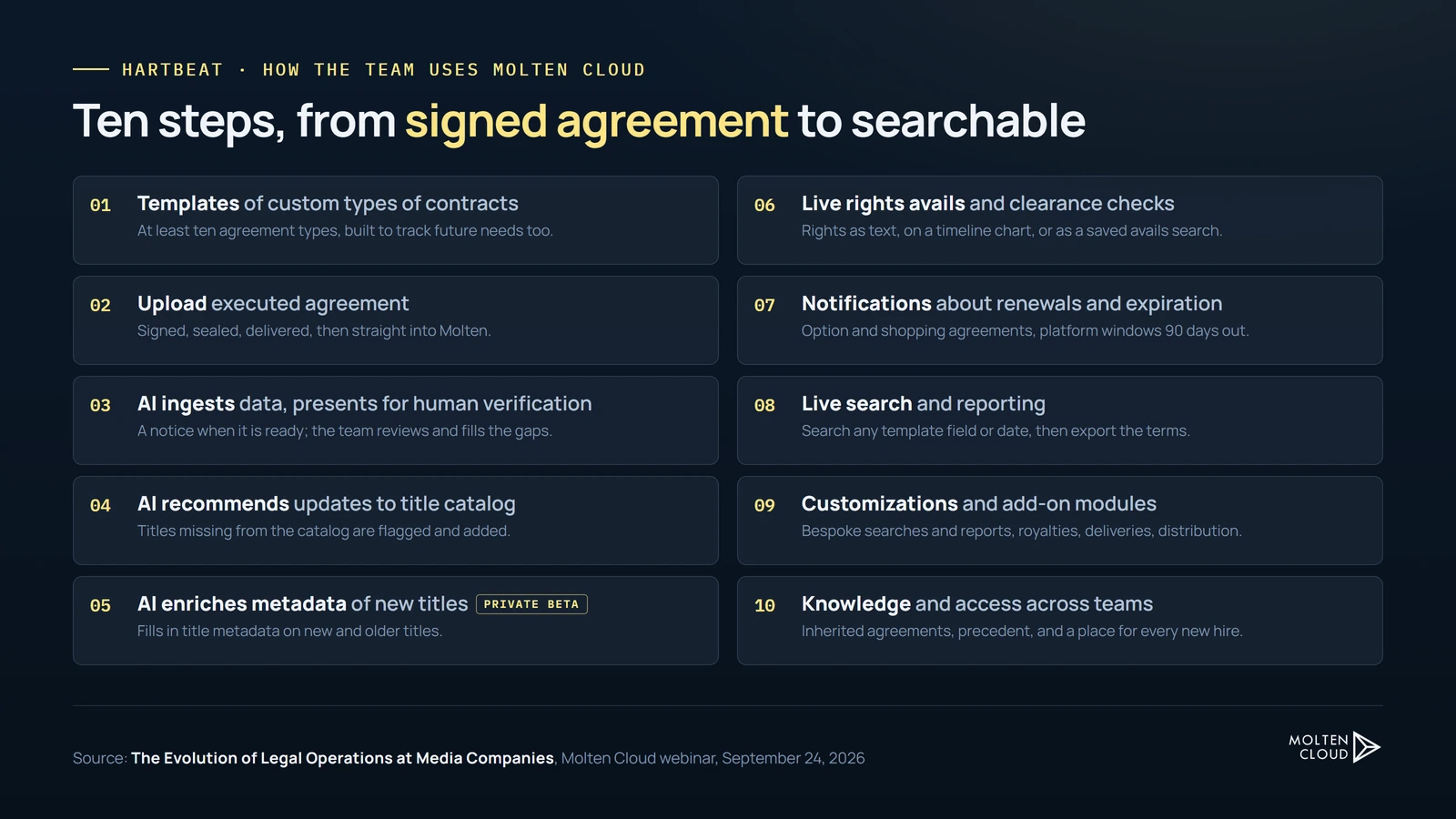
1. Templates of custom types of contracts
Hartbeat has at least ten agreement templates in Molten, by Vical's count: licenses, distribution in and out, shopping agreements, production services agreements and more. They were built with the Molten team to track what the department would need later, not only what it needed on day one.
“We tried to be mindful of the types of things that we would want to track, even if it wasn't right then, but in the future, just to make sure that the foundation was set for us to be able to go in later and add in the information that we thought would be necessary.”
Vical Peterson Brunious, Attorney and Senior Contract Manager, Hartbeat
2. Upload executed agreement
Once a deal is signed, sealed and delivered, the executed agreement is uploaded into Molten.
3. AI ingests data, presents for human verification
The AI takes the first pass and parses what it can. A notification says the agreement is ready for review, which opens on a summary. If the agreement covers a title that is not yet in Molten, the system flags it and adds it, so nobody creates it by hand. The team then reviews the terms that were populated, double checks them, and adds what the AI did not fill in.
“Even if you don't have time to do that, at least the agreement is in there. So you can still search certain fields based on it, just on the AI ingest.”
Vical Peterson Brunious, Attorney and Senior Contract Manager, Hartbeat
4. AI recommends updates to the title catalog
As Arjun explained, when a contract covers some titles already in the catalog and some that are not, Molten recommends the updates, which is the title flag Vical described at review.
5. AI enriches metadata of new titles
Also from Arjun: a newer capability, in private beta at the time of the webinar and not yet part of Hartbeat's setup, that enriches the metadata of newly ingested titles and older ones.
6. Live rights avails and clearance checks
Once an agreement is in, its rights are live. Vical described two views: the rights laid out as text, or the titles view, a timeline of what is available across a timeframe. An avails search can be run and saved, to keep track of what is available and what is not.
7. Notifications about renewals and expiration
Vical uses notifications to track rights that might be expiring. On shopping agreements and option purchase agreements, an alert gives the team time to ask for an extension, if the other party is amenable, or to check how the project is progressing. For distribution, a notice that content on a platform will be up in the next 90 days goes to the business team, to decide whether to keep it there.
“It also gives them a chance to kind of reevaluate our agreements and where to continue and where not to.”
Vical Peterson Brunious, Attorney and Senior Contract Manager, Hartbeat
8. Live search and reporting
Requests about the agreements are answered with a search on a field. Vical's example: someone asks for every agreement with some sort of financial obligation, and she pulls them up and exports them, with the terms showing whether it is a percentage, a revenue share or a fee, and the payment terms. The same approach answers whether an agreement is assignable, or which MSAs expire as the end of the year approaches, by searching on a date.
9. Customizations and add-on modules
Getting searches and exports to return exactly the right information, on a contract basis or on a title basis, has been a joint effort. Asked whether she had worked with the Molten team on bespoke exports or reports, Vical answered: “They're probably sick of me.” Arjun added that reports can now be built and modified from the system's settings, and that add-on modules cover royalties, content and file distribution, deliveries and schedulers.
“Your team's always been super helpful with trying to help us learn and navigate within Molten.”
Vical Peterson Brunious, Attorney and Senior Contract Manager, Hartbeat
10. Knowledge and access across teams
Hartbeat's legal department was new, and it inherited agreements that predated everyone on the team. When someone asks about one of them, it is in Molten and the terms can be checked. The same search serves drafting: if someone remembers drafting a point but not where, they can find the agreement it came from and look at similar ones before drafting the next. And because Molten offers unlimited users, new team members get access to that knowledge as they join.
“Having all that information, even just from a historical standpoint, has been very helpful.”
Vical Peterson Brunious, Attorney and Senior Contract Manager, Hartbeat
To close the segment, Arjun ran a contract through the AI ingest live, from upload to a reviewed contract with its titles created. Asked whether that was representative of Hartbeat's workflow, Vical answered: “Yes, yep.”
Or see what is coming next in the calendar of upcoming Molten Cloud webinars.